


 Cart
Cart
 sales@molnova.com


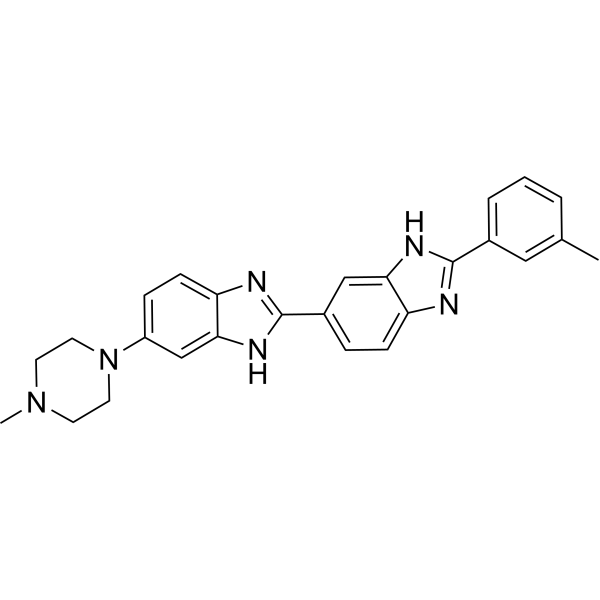
Hoechst 33258 analog 2
CAS No. 23491-54-5
Hoechst 33258 analog 2( —— )
Catalog No. M27036 CAS No. 23491-54-5
Hoechst 33258 analog 2 is part of a family of blue fluorescent dyes used to stain DNA.
Purity : >98% (HPLC)
 COA
Datasheet
HNMR
HPLC
MSDS
Handing Instructions
COA
Datasheet
HNMR
HPLC
MSDS
Handing Instructions
| Size | Price / USD | Stock | Quantity |
| 5MG | 312 | Get Quote |


|
| 10MG | 447 | Get Quote |
|
| 25MG | 714 | Get Quote |
|
| 50MG | 1017 | Get Quote |
|
| 100MG | 1368 | Get Quote |
|
| 500MG | 2673 | Get Quote |
|
| 1G | Get Quote | Get Quote |
|
Biological Information
-
Product NameHoechst 33258 analog 2
-
NoteResearch use only, not for human use.
-
Brief DescriptionHoechst 33258 analog 2 is part of a family of blue fluorescent dyes used to stain DNA.
-
DescriptionHoechst 33258 analog 2 is part of a family of blue fluorescent dyes used to stain DNA.(In Vitro):The dyes Hoechst 33258 and Hoechst 33342 are the ones most commonly used and they have similar excitation/emission spectra. Both dyes are excited by ultraviolet light at around 350 nm, and both emit blue/cyan fluorescent light around an emission maximum at 461 nm. Unbound dye has its maximum fluorescence emission in the 510-540 nm range. Hoechst dyes are soluble in water and in organic solvents such as dimethylformamide or dimethyl sulfoxide. Concentrations can be achieved of up to 10 mg/mL. Aqueous solutions are stable at 2-6 °C for at least six months when protected from light. For long-term storage, the solutions are instead frozen at ≤-20 °C. Although the dyes can bind to all nucleic acids, AT-rich double-stranded DNA strands enhance fluorescence considerably. Hoechst dyes are cell-permeable and can bind to DNA in live or fixed cells.
-
In Vitro——
-
In Vivo——
-
Synonyms——
-
PathwayOthers
-
TargetOther Targets
-
RecptorBCRP| Parasite
-
Research Area——
-
Indication——
Chemical Information
-
CAS Number23491-54-5
-
Formula Weight422.536
-
Molecular FormulaC26H26N6
-
Purity>98% (HPLC)
-
SolubilityIn Vitro:?H2O : < 0.1 mg/mL (insoluble))
-
SMILESCN1CCN(CC1)c1ccc2nc([nH]c2c1)-c1ccc2nc([nH]c2c1)-c1cccc(C)c1
-
Chemical Name——
Shipping & Storage Information
-
Storage(-20℃)
-
ShippingWith Ice Pack
-
Stability≥ 2 years
Reference
1.Robinson MW, et, al. The comparative metabolism of triclabendazole sulphoxide by triclabendazole-susceptible and triclabendazole-resistant Fasciola hepatica. Parasitol Res. 2004 Feb;92(3):205-10.
molnova catalog



related products
-
9-Ethylcarbazole
9-Ethylcarbazole is an agent of biochemical.
-
Epithalon TFA
Epitalon TFA is an anti-aging agent and telomerase activator.Addition of Epithalon peptide in telomerase-negative human fetal fibroblast culture induced expression of the catalytical subunit, enzymatic activity of telomerase, and telomere elongation, which can be due to reactivation of telomerase gene in somatic cells and indicates the possibility of prolonging life span of a cell population and of the whole organism.
-
Cyclocurcumin
Cyclocurcumin, a curcumin derivative, exhibits anticancer, anti-inflammatory, and immune-modulating abilities and is a potential compound for the treatment of rheumatoid arthritis as predicted by the MM-PBSA method.
